
Why High Heels and Prague’s Cobblestone Streets Don’t Mix
High-heeled shoes are beautiful and ingeniously designed instruments of torture. At least that’s how it feels when you try to walk in them along Prague’s streets, full of small, large and uneven cobblestones. That made me reflect on why I personally don’t wear heels very often. The main reason: the condition of Prague’s pavements.
Spending an entire day on small, uneven cobblestones requires intense physical and mental preparation, followed by long hours of recovery. Women who claim they can spend a whole day in high heels in Prague without suffering any consequences strike me as hired agents of male heel fetishists.

September 2011, New York, shortly after the presentation of Gant’s spring collection. Crowds of beautiful women, all wearing sky-high heels, smiles on their faces, loud laughter. But all it takes is turning the corner and those same beauties immediately kick off their heels, hide them in their handbags, pull out trainers or ballet flats, and walk away with visible relief.
I have witnessed similar scenes at many other major fashion shows. High heels are beautiful, women and men love them, but walking in them is simply not practical. It should be noted, however, that in the fashion world, a shoe with a heel lower than eight centimetres is considered little more than an upgraded slipper.
Czech women are said, to the disappointment of many men, not to have a particularly warm relationship with high heels. At least according to an article that appeared in Elle magazine in June — which claimed this is a great shame, as women in the Balkans practically never take their heels off.
I therefore reflected on why I personally don’t wear heels very often. The main reason: the condition of Prague’s pavements. Spending an entire day on small, uneven cobblestones requires intense physical and mental preparation, followed by long hours of recovery. Women who claim they can spend a whole day in high heels in Prague without any ill effects strike me as hired agents of male heel fetishists.
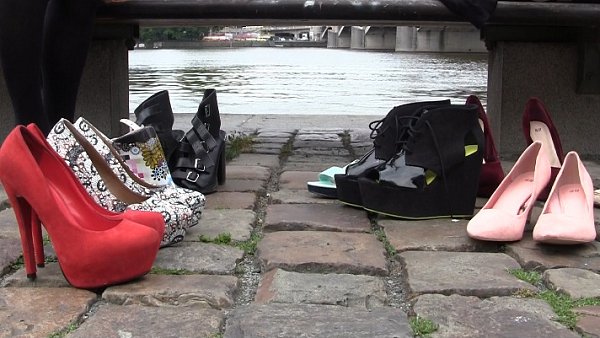
The only solution for women who love high heels are special smooth-surface walking strips that make movement easier not only for women, but also for people with disabilities. In Prague, they can be found for example on Na Příkopě Street or along the river embankment. In the city centre, however, you have to fight for space with tourists dragging suitcases, and by the river with cyclists. A special walking strip reserved for women in heels, prams or the visually impaired appeared last year in the centre of Hradec Králové as well. Similar measures are expected to be adopted later this year by Rome, which plans to install such strips in its busiest pedestrian zones. The Italian capital has taken inspiration from Milan, where similar strips already exist on the main shopping street, Corso Vittorio Emanuele II.
Women vs. Men
So what do people actually see in heels? Calves look better in them, the foot appears smaller, the wearer taller and slimmer. Simone de Beauvoir, however, saw them as part of a male effort to immobilise women. According to the French philosopher, clothing, footwear and accessories are meant to turn women into objects – helpless and easy to control. Artificial nails effectively deprive women of their hands, corsets once made normal breathing impossible, and high heels practically deprive women of their legs.
Christian Louboutin, the famous shoe designer known for his provocatively red soles, sees advantages in high heels as well. He proudly tells the story of a customer who bought her first pair of court shoes from him. They were beautiful, but difficult to walk in, and her commute to work suddenly took twice as long. “For the first time on her way to the office, she actually noticed what she was walking past and discovered many things she had previously overlooked,” he boasts.
The British central bank, meanwhile, organised a special Dress for Success seminar for its female employees in 2009, where women were told to wear heels to work (no higher than five centimetres) and lipstick. Supposedly, this would guarantee them greater success with clients. Undoubtedly.
The article and image were taken from Hospodářské noviny dated 21 July 2012
Title image by to.wi from Flickr


